Monday, October 26, 2026

Wishing for a White Christmas?

 In January 1876, snow lay on the mountains for over two weeks. It had already been a wet winter with rain starting in earnest in November 1875. This latest snow storm had blanketed almost the entire state and mail delivery from the east failed to reach San Francisco due to a snow blockade. On Ben Lomond Mountain the snow was ten inches deep. Boulder Creek was covered with three to five inches of the powdery stuff and “The promiscuous manner in which snow balls flew about … was astonishing.”

The heavy weight of the snow and the strong southerly wind did much damage with many fallen trees and broken limbs. The flume which carried cut lumber from just north of Boulder Creek to Felton suffered severely from the fallen timber.

Then just a week later another relentless rainstorm pummeled the area. The high tide and rapidly rising San Lorenzo River caused flooding the lower sections of Santa Cruz and the storm laid down more snow on the surrounding mountain tops. This was to be a very cold and wet winter. By the end of February, the coastal range peaks had been covered with more than a foot of snow at least three times. Then in March, again the mountains wore a “fleecy mantle.” Hail showers halted operation of the railroad, the whole county was a “sea of mud and water,” and business was at a stand-still.

1993-XXX-0026

1993-XXX-0027

Through the historic record, snow in the Valley and in our mountains during the winter was not uncommon, though usually just a sprinkling which melted with the winter sun. A cold snap in 1884, however, saw eighteen inches of snow on Loma Prieta’s peak with snow drifts that were waist deep.

In January 1907, over 12 inches of snow was estimated to have fallen in Boulder Creek, accompanied by a heavy storm of sleet and rain. It was deemed the greatest snow storm since 1873. Santa Cruz Sentinel, January 8, 1907:

Snowball parties are the rage and on every street small bands of men and women can be seen carrying baskets filled with balls of snowy whiteness and icy hardness. All that one has to do is to poke a head outside the door an “bang!” here come a snowball on its mission of fun and mirth. The different fraternal orders formed into companies and Sunday afternoon had a grand battle on the school grounds, the fight resulting in a drawn battle between the Maccabees and the Knights of the Golden Circle. Down town there was a high spirited contest between the “Scrap Irons” and the “Bow Wows” that progressed more or less fiercely the entire day and far into the night, attended with an effusion of blood as the combatants warmed up to their work. … ‘Tis a glorious taste of winter frolic and all are enjoying it while it lasts.

On January 7, 1907, Charles Brimblecom wrote in his diary:

The ground was still covered with snow this morning, and sleet and half frozen rain coming down. About noon it snowed heavily again, covering the ground more thickly than yesterday, and bending down the bushes and young timber. … I hope the “beautiful snow” will soon melt off, for I like it not.

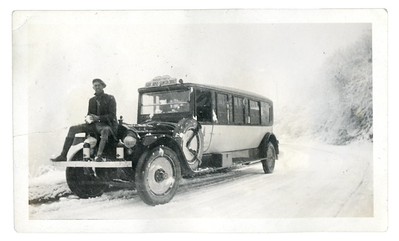
Santa Cruz Stage Co. omnibuses on the San Jose to Santa Cruz road, now Highway 17, on a snowy day in 1925.  
2013-035-0002-p054c-web 2013-035-0002-p054a-web

Most often, snow flurries here during the months of January through March, but in 2008 we did see December snow plows clearing the roads across the mountain peaks.

Snow on Highway 9, December 16, 2008, photograph by the author.


Sunday, October 25, 2026

Love Creek Water Elevator

In 1901, John Armstrong of Santa Cruz patented an automatic water-elevator. The device used a small amount of water with considerable fall, to move a portion of that water to a higher elevation.

A tower would be erected in a gulch where the top of the tower would be around five feet below a spring. Water was piped to the top of the tower and allowed to fall into buckets attached to an endless chain. When the buckets were full, about every four minutes, the chain moved, setting the pump to work for one minute forcing the water upwards to its destination. Advertisements for the elevator boasted it could raise water up to 450 feet.

John Armstrong's Patent No: 682,378.

One of the first to be installed was on Love Creek, Ben Lomond for Martha Hume. Her home was 400 feet above the creek and she had no convenient way of getting water to the house. It was highly successful. Sadly, it was vandalized two years later when someone with a sharp hatchet cut and destroyed all the buckets on the machine. A second elevator was installed for her in 1904 which raised water 523 feet.

The elevators were manufactured by Joseph Harveston at the Lukens Carriage Works in Santa Cruz. In 1904, Harveston installed one in the San Lorenzo Rover at Boulder Creek for farmer Conrad Shroeder. Shroeder had tried using a rotary pump driven by an undershot water wheel without success. “He got out of patience … and now gets all the water he needs.” The elevator raised a one-and-a-half-inch stream of water to irrigate Shroeder’s land which was around 200 feet above the river.

In 1905, the new Harveston & Lukens Automatic Water Elevator was awarded first prize at the State Fair.

E. Lukens Carriage Works

Article from Feb 17, 1905 Santa Cruz Sentinel (Santa Cruz, California)

Also in 1905, a poem was written about it by Ella J. Collar and published in the Santa Cruz Sentinel:

The Automatic Water Elevator by Ella J. Collar

Way down a steep flight
And quite out of sight,
There’s a magical mill,
Built under the hill,
And run by a stream,
Without any steam.

It runs day and night
By the same silent might,
And though in a deep gorge,
Shut out from the light,
It seldom murmurs
Of its lonely plight.

A grander machine
The world never seen;
‘Tis like a rare jewel
In a crown that was set,
Although never wore,
It shines ever more.

Thus the glory of the pump,
Its true worth unseen,
Except by the trickle
Of the ascending stream,
Its true value is known
In the stream that is thrown

To the tank far above
In the broad light of day,
Silent but constant
It forces its way,
And giving full credit
To the mill that just had it.

Saturday, October 24, 2026

The Ax-men had to Swing Themselves from Bush to Limb

 In 1864, a bill was before the Legislature to build a road from Santa Cruz to Redwood City across the Santa Cruz Mountains. The road, which was estimated to cost $40,000, “will actually be the making of that city.”  It would open up the beautiful valleys of the San Lorenzo and the Sayante for development.

It wasn’t until 1866 that a preliminary survey was conducted “so rugged were the steep banks of pine and undergrowth.” It took a couple of months for Ambrose Calderwood and his team to cut the brush away to make a trail along the route but “so difficult was the job the ax-men in places had to swing themselves from bush to limb to make headway …”

By the end of 1866, it was reported that 12 men were working on the road taking out stumps. The upper end was graded down from Ferguson’s Farm [Felton] to Gold Gulch and was now “barely passable for horsemen.” But it was not a road that could carry the heavy loads of lumber and lime out of the Valley to Santa Cruz.

So, in 1867, surveyor Thomas Wright was asked to survey a route for the construction of a sixteen-foot-wide road.  Commissioners Frederick Augustus Hihn (entrepreneur), John W. Towne (farmer) and John D. Chase (Chase’s Meat Market) formed the committee for overseeing the building of this crude road.

The committee asked for bids to be submitted by January 11, 1868 and work to be completed by May 1 of the same year. The middle of the road was to be sixteen inches higher than the inside and eight inches higher than the outside. All curves had to be [a minimum of] 100 feet radius and the slopes of the banks had to be two-fifths of the height of the cut. All rocks and roots had to be removed down to the level of the inside of the road, and culverts and bridges had to be built where needed.

Three bids were submitted, including a bid from George Ulmer Collins of Zayante and a partner for $6500. But it was the lowest bid of $6000 from Stanley, Bennett, and Palmer that was accepted and Superintendent Eben Bennett lost no time advertising for 100 men to perform the arduous work.

On the grade near Felton, Charles W. Nystrom, Bancroft Library, UC Berkeley, California.

The road was formally handed over to the commissioners on April 25, ahead of schedule and a huge celebration took place at the San Lorenzo schoolhouse at the upper end of the road where “’a splendid lunch was laid out.” A speech by John Stanley, the primary investor, thanked the other donors who had financially supported the project and he proclaimed:

The road is now finished, gentlemen: it is yours, to remain open and free, forever. It is dedicated to the public and the public should keep it in order, and see that it is kept open and remains free.

The band played and a dance ensued.

To keep the road open, and to pay for the constant repairs needed, the residents of the Valley were taxed annually. Use of the road was also subject to a fee and a tollhouse was built at which the toll was collected. George Collins and Eben Bennett were among the first of the toll keepers.

For more on the Toll House visit scmhistory.blogspot.com/2026/09/felton-toll-gate-house.html.


The Eyes that Never Sleep

In the 1930s, the Santa Cruz Mountains were being watched, from 5am to 10pm, by lookouts stationed in lookout towers on five peaks. Referred to as "the eyes that never sleep," these men and women lookouts tirelessly scanned the landscape for signs of fires.

In 1942, during WWII the Aircraft Warning Service mobilized the fire lookouts as enemy aircraft observation points. Two or more watchers scanned the skies 24 hours a day, 365 days a year until the war was over.

The first to be erected, in 1922, is on Mount Bielewski, in Castle Rock State Park. It was the first fire lookout tower in California to be funded by the State Board of Forestry. The 60-foot steel tower had a ladder to reach the lookout post. This was later replaced by a staircase. Miles of telephone line directly connected the tower to the California Redwood State Park (Now Big Basin Redwoods State Park) and through the efforts of three local ranchers, to the Los Gatos telephone network.

The tower was dedicated on a Sunday afternoon in July. About 250 people attended the "simple but impressive" ceremony. State Forester M[erritt] B. Pratt talked about the usefulness of the fire lookout station system being established by his department, and that "this being the first one of these projects, Santa Cruz County may consider itself fortunate and honored." It cost almost $5000 to build. 

Visitors were welcome to the tower and local residents Simon and Rachel Herring of Los Gatos and Joseph and Anna Herring of Los Angeles gave the gift of a telescope to the tower for use by the towerman, Fred Herring, (their son and brother respectively,) and visitors alike.

The second to be built was the Loma Prieta tower in 1927. This wooden tower was dismantled and rebuilt in 1934, taller and in steel. This tower proved to be very popular with visitors. In fact, between 1927 and 1933, 5180 visitors had registered at the site. In 1934, for some reason, thieves broke a window to gain access to the tower and stole the visitor register. It closed in 1979.

In 1935, a suppression station with a tower on the Summit close to the intersection of Skyline and Highway 9 was completed. The lookout tower was built on top of a 5000-gallon capacity water tower and was 40 feet high.

Two more were completed in 1938, both on what is today Big Basin Redwood State Park land; one on Eagle Rock that was unfortunately destroyed by fire in 2018, and one on Chalk Mountain, the most isolated in the County.

The dedication of the Eagle Rock Lookout too place on Sunday, July 31, 1938. At that time, the land on which it stood was the Locatelli Ranch. Nearly 500 people attended the dedication and partook of the free barbecue sponsored by the Farm Bureau, granges, chambers of commerce, and the San Lorenzo Valley Property Owners' Association.

The main caravan of attendants left the courthouse here at 10:30, while scores of others went singly an in groups by automobiles from various points in Santa Cruz and Santa Clara counties. The drive, intended to coordinate all forestry projects from San Francisco to San Luis Obispo, was epitomized by State Forester M[erritt] B. Pratt, who pleaded for a program of "multiple use forestry" under perpetual public ownership.


Eagle Rock Lookout Dedication

Article from July 31, 1938 Santa Cruz Sentinel (Santa Cruz, California)
Charles Wilcher, Felton ranger, with the help of a large map, outlined the location of the sosoom to be fully operational lookout stations to eliminate every "blind spot" in the county. The lookout at Eagle Rock was to be George Heathborne.

Eagle Rock Lookout, view 2, August 1954, Cal Fire Museum

The Chalk's lookout, manned in the 1940s by a Mrs. Sweet, a petite, 57 year old ex-accountant, was closed in the mid-1960s. During the 1960s and 70s most of the fire lookouts, and the dedicated fire spotters, were phased out. At one time there were over 600 in California.

Mount Bielewski and Eagle Rock were among the last to be closed in 1992 due to lack of funding, an act that was seen to be short-sighted at the time, since it only cost about $52,000 per year to operate the two towers during the fire season - a fraction of the cost of fighting a fire. 

Today, some of the lookouts have been converted into holiday cabins, nine of which are in California. You can rent the lookouts through an organization called recreation.gov.

Tuesday, October 20, 2026

MAMMOTH REDWOOD BURL “MINED”

MAMMOTH REDWOOD BURL “MINED” ON THE TIMBER CLAIM OF GEORGE HARTMAN, ON KING [sic] CREEK, FOUR MILES ABOVE BOULDER CREEK.

Transcribed excerpt from the Mountain Echo newspaper, February 3, 1912:

Sempervirens “Burl” Redwood is a vegetable growth that is rapidly disappearing, partaking much of the nature of a freak, and is pre-eminently a California vegetable monstrosity. It is never found other than UNDER the ground, and ONLY as the root of the “SEQUOIA SEMPERVIRENS.”

Don’t confuse “Burl” with “curly redwood” or “birdseye”; “curly redwood” is a wavy grain of the wood split from the trunk of the tree; “birdseye” grows in the form of an excrescence or wart, on the trunk of the tree, above ground, and while it slightly resembles “Burl,” it is wholly lacking the beautiful effects of flowers, leaves and tracings of nature that appear in the grain of polished “Burl.” Both “curly redwood” and “birdseye” are found in all species of redwood, “Burl” only in the Sequoia Sempervirens.

“Burl” grows like a turnip, IN THE GROUND; imagine a huge, oval-shaped turnip, from 6 to 20 feet across the top, and all the way from 2 to 7 feet deep, and you have a fair idea of the “Burl” as it is found in its native state. Boulder Creek is the only place on the Pacific Slope where the prospecting, mining and preparation of these monster freaks is carried on as a business. It was here their discovery was made, and it was established as a rival of eastern and foreign hardwoods for decorative, furnishing and finishing purposes, through the investigation and experiments of A. J. Baldwin, a Boulder Creek resident, and from whom it takes its name, “Baldwin Burl,” by which it is known to the trade.

Mammoth Redwood Burl "Mined," Mountain Echo, February 3, 1912.

Baldwin's Burl

In 1904, Andrew Jackson Baldwin, a redwood artist, noticed that there was a huge burl on the road to Big Basin. In fact, when the road first opened it ran right over the burl. Over the next twenty years, the traffic slowly eroded the soil and the burl became an obstruction. 

No one realized its value until it was examined by Baldwin. He negotiated a deal for its extraction with the owner of the land, Fannie Welch, and mined the enormous "turnip." It was circular, twenty-seven feet in diameter and from one to three feet thick. In order to transport it to Joseph Peery's sawmill it had to be cut into forty-three sections. It was estimated to yield 10,000 board feet of beautiful burl lumber; at half the going rate of $2 per board foot, that’s $10,000. Several of the milled boards were one and a half inches thick, two-feet wide and ten feet long, which he purportedly sold for saloon bar tops. The boards and planks were considered "the finest lot of burl redwood that has ever been cut in the state."

"Freakish Timber"

In 1905, the Pacific Monthly, February 1905, Volume XIII Number 2, wrote about the transition to valuing the "freakish timber" at the base of redwood trees:

It is but a few years since lumbermen in California’s redwood districts, when taking the trees, made the first cut about fifteen feet above ground, discarding all wood below that mark because it nearly always contained freakish timber and would not work up into straight-grained boards. They have learned to do differently. Nowadays this same scorned stump part has world wide fame; it is one of the choicest and most sought-after of woods for the cabinetmakers art; and carloads have been eagerly bought up and shipped to Europe by agents, sent out here expressly to get it. The grain of “curly redwood,” when polished stands out in exquisite shadings, showing its silken lines as clearly as if a wood-nymph’s wavy tresses had been perpetuated in the tree.


Monday, October 19, 2026

The Native Daughters of the Golden West Petition to Save the Big Basin

Transcribed here is the Native Daughters of the Golden West's petition to save the Big Basin. It is an example of how early women’s groups—despite being unable to vote—successfully organized and petitioned to establish the foundations of the California State Parks system. The resultant public pressure culminated in legislative action and the purchase by the state of land owned, and held in "trust" while the state stalled, by lumber baron Henry Lewis Middleton in anticipation of California's first redwood state park.

The Journal of the Senate During the Thirty-Fourth Session of the Legislature of the State of California, 1901 (Sacramento: A. J. Johnson, Superintendent State Printing, 1901), 272:

In the Senate Monday January 28, 1901.

To the Honorable the Legislature of California:

Honorable Sirs: We, the Native Daughters of the Golden West, do most earnestly and respectfully invite your acceptance and favorable consideration of this petition relative to the preservation of the forests of California. As native daughters, both as an order, through our grand officers, and as individuals (as witness the signatures to our petition), we indorse the work of the Sempervirens Club, and implore your aid to secure the preservation, in the form of a Government park, of the wonderful primeval forest of coast redwood known as the "Big Basin," and its immediate environments, located in the Santa Cruz Mountains; a solid body of magnificent redwood--the oldest specimens of plant life known.

We call upon you, our worthy and trusted representatives, to give your effective aid to this patriotic project, either by appropriating sufficient money from the State Treasury to purchase the land outright, or by instituting condemnation proceedings on the ground of public utility; in brief, to set in motion the machinery of the law immediately to save these forests from destruction.

The welfare of our entire State depends upon the prosperity of each and every section. The "Big Basin" lies in the counties of Santa Cruz and San Mateo. Its destruction means the lessening of the rainfall of Central California, and the loss of the water supply of Santa Cruz, San Mateo, and Santa Clara Counties, and of the City of San Francisco.  This would be a public calamity. We pray you to avert it by saving to us, to our beloved California, and to the generations yet to come, this magnificent forest--the growth of many centuries.

For the honor of California, we are

Yours respectfully,

Ema Gett, Grand President; Genevieve Baker, Grand Vice-President; Laura J. Frakes, Grand Secretary; Dora Zmudowski, Grand Treasurer; Harriett Stoddard Lee, Grand Trustee; Mamie A. Ryan, Grand Trustee; Emma G. Foley, Grand Trustee; Stella A. H. Finkeldey, Grand Trustee; Mary J. Langford, Grand Trustee; and 1,000 members of the order.

Commercial Hotel, Boulder Creek, Gateway to the Big Basin

Below is the Commercial Hotel which was built in 1897 by Middleton. 

XXXX-XXX-5109-web

Middleton, who was often referred to as the Mayor of Boulder Creek, recognized the importance of his first growth redwood holdings in the Big Basin and it was here at the hotel and on his Big Basin holding where he lavishly entertained dignitaries to promote the formation of the park.

Mayor Middleton

Article from Aug 9, 1902 Evening Sentinel (Santa Cruz, California)


The hotel was renamed Big Basin Hotel in 1914.

Sunday, October 18, 2026

Felton Fuse Factory Explodes

In 1869, a fuse factory was erected on Zayante Creek in Felton. The company was incorporated as Lake Superior and Pacific Fuse Company and the principal stockholders were the inventors and patentees Richard Uren, Thomas Dunstone, and Joseph Blight. The plant was also known as the Eagle Fuse-works.

Map of Santa Cruz County, 1881, Wright, Bennett, and Healy.

The machinery was driven by three 5-hp water wheels. Water was supplied to the factory by a flume from a reservoir fed by water from Bean Creek.

The main building was three stories high with a two-story wing. The wheels, pulleys, shafts, etc. that drove the fuse making machinery were on the lower floor; the actual fuse making on the second and third.

US Patent No. 37079
The fuse making process was kept a tightly held secret. The Santa Cruz Sentinel reported:

We did not see the second story of the works in operation, as that portion of the building is private and sacredly confidential, the various processes and machinery being a profound secret, never divulged by the inventors and patentees.

Jute, one of the raw materials, was imported from Dundee, Scotland. The finished product, which was “used all over the Pacific Coast,” was also exported to Australia and Central America. 


In 1871, the factory production capacity was increased to 120,000 feet of fuse per week. After Thomas Dunstone’s death in 1878, his son-in-law William H. Talbot took over the operation of the factory. In 1881, South Pacific Coast railroad employee, Joseph H. Aram, married Evangaline, Dunstone’s daughter. SPCRR issued the following congratulatory statement:

SPCRR tender you and your bride our sincerest congratulations on your marriage, with the hope that your future happiness will burn as bright as the fuse, and never die out till it burns to the end.

In 1883, Talbot, Dunstone’s widow Susan, and Aram formed a partnership under the name W. H. Talbot & Co. “for the purpose of manufacturing patent fuse and farming.”

On a fateful day in August just one year later, Aram was working at the plant, when there was an explosion in the room above him. He was watching the machinery that fed powder from hoppers in the room above into the fuse, to ensure that it was working correctly. Aram saw the roof raise up, and the sides of the room he was in spread out. Hurriedly he ran to a window intending to jump out, but as he reached the window a second explosion occurred throwing him out. He suffered a fractured arm and was badly bruised. The building was soon engulfed in flames and burned to the ground. It was uninsured and never rebuilt.

2011-011-0001-p15-1

Aram, pictured here some years later at his home in Felton, lived very close to the Fuse Factory site. He was the railroad station agent for Felton, and later Boulder Creek.


Gulching

Gulches—deep, narrow ravines created by rainfall during the winter storms—provide a crude, natural pathway up and down the steep hillsides of the Santa Cruz Mountains. The term “gulching,” in reference to the transport of lumber via the gulches, seems to be a curiously Santa Cruz County term. The first references to the term gulching in the Santa Cruz Sentinel are found around 1870 when Mark McClennan describes a contract between himself and George and Henry Francis to gulch “powder wood” on the Zayante Creek.

Often the wood that was gulched was fallen timber that would otherwise become fuel for forest fires. It was collected in the late summer or early fall when the wood was drier and hence lighter. This gulched timber was generally sold for stove wood.

In 1898, a fire raged around Boulder Creek. So close were the flames that they threatened the schoolhouse and ignited the brush in the play-ground. The logging and gulching roads skirting the town helped to save it from destruction. Back fires were set with the gulching roads acting as fire breaks. The back fires met the approaching flames and with the help of a heavy fog and little wind the fires burned themselves out by the following morning.

Pictured here is a team of mules ready for gulching. They are wearing wooden sawbuck pack saddle trees on their backs with a two iron brackets slung over them, one on each side, to which the gathered split stuff is attached.

XXXX-XXX-5311-web

Mules, the offspring of a male donkey and a female horse, with their sure-footedness, were better suited to working on the steep slopes than horses. Males are called horse mules and females are called mare mules. In 1884, the Olive and Foster lumber company boasted four-, six-, and eight-horse [mule] teams gulching and hauling lumber to Santa Cruz. In 1895, Winfield Scott Rogers, editor of the Mountain Echo, operated a team of 13 pack mules and 25 men stripping tan oak bark and gulching it out of the Big Basin. The bark was destined for the tanneries of which there were then three: Kirby, Boston & Jones, and the Kron & Sons Tanneries. He gulched 825 cords of tan oak bark for which he was paid $8.50 per cord.

It could be dangerous work. Animals were lost as they fell to their death down the steep ravines. 

Santa Cruz Sentinel, August 17, 1896:

Wm. McKean, while gulching in the Little Basin, lost a valuable horse. It fell over the grade and was killed.

The Hihn Co. was gulching at Gold Gulch when a mule slipped away from the rest of the pack-train carrying half a cord of pine wood. It managed to safely cross a high railroad trestle. The Sentinel reported: “Had the exaggerated Belgian hare toppled over the edge, he would, at least, have had time to say his prayers before striking the bottom, as the trestle is 100 feet in height.”

XXXX-XXX-5306-web

Wednesday, October 14, 2026

If Only Walls Could Talk

Pictured here is the Piedmont Hotel as it was around 1912. The McAbee brothers, Orin and Willard, founders of the long established, but now closed Southern Lumber Company, sold their Universal Hotel property on the corner of Mountain and Highway 9 to Peter Ricca of San Francisco, an experienced hotelier and restaurateur.

2011-004-0001-p03-cropped

Ricca owned the hotel and restaurant, which had been operated by John Ercole, up until early 1920 when it was sold to Ugo Giomi and W. D. Alexander. 

The hotel was to be renovated and modernized ready for the summer tourist trade. It was reopened later that year under the name of The Big Basin Inn serving delicious Italian dinners, with a new dining hall, handsome fireplace, and dance floor. The cottages had been renovated and the hotel grounds were being laid out in walks with beautiful flowers. Dinner, with dancing, was just $2 a plate.

The partnership did not last long, and in July of 1920, Alexander sold his interest to Giomi. Alexander would become the proprietor of the Boulder Creek House on the corner of West Park Avenue.

Giomi changed the name of the establishment to Ugo’s Tavern and it operated under that name until, in 1939, Giomi suffered a severe stroke.

XXXX-XXX-5121-web

1991-XXX-0007-web

XXXX-XXX-5136-web

In 1940, it was purchased by a San Francisco business woman Faith Garabaldi. Again, the property was remodeled. A “Blue Bar,” extending across the front of the building was finished in blue and ivory knotted pine. When the hotel opened under the new name of Boulder Creek Lodge over 150 guests were in attendance. The menu changed too; chicken and steak dinners were accompanied each Saturday night by a special dancing event to a Hill Billy Orchestra.

2003-XXX-0139-web

A miniature golf course was added where golf tournaments were held during the town’s “Timber Days” celebration.

Boulder Creek Lodge Miniature Golf

Article from Jul 28, 1950 Santa Cruz Sentinel (Santa Cruz, California)

Ownership changed to Joseph Overman, his wife Margaret, and their daughter and son-in-law, Margaret and Fred Hansen. They built a swimming pool which was opened to celebrate the Overman’s 55th wedding anniversary in 1957. Joseph added eleven cabins to the lodge property. The Overmans passed away within a few months of each other in 1965 and the property again changed hands.

Now known as “White House Corner,” this property however has a much longer history. Perhaps one of the oldest buildings in the San Lorenzo Valley stills lies in the depths of one of its structures that has seen so many renovations and modernizations over the years.

The Piedmont Hotel had been a merchandising store for over twenty-five years prior to becoming a hotel. It was Cottrell's Store.

XXXX-XXX-5018-web

Built in 1874, in Joseph W. Peery’s town of Lorenzo and owned first by Charles C. Cottrell and later by Samuel H. Rambo (State Senator 1905-1907), this building witnessed the flume being built in 1875, the coming of the railroad in 1885, the birth of the town of Boulder Creek, and the destruction of Lorenzo in 1897, when fire ravaged the structures on the south side of Highway 9.

Santa Cruz Evening Sentinel, April 16, 1897:

The store of S. H. Rambo, across the street from the burnt district, had a close call from destruction, and was only saved by hard work on the part of the bucket brigade, assisted by wet blankets.

If only walls could talk!


Friday, October 9, 2026

The Entrance to Big Trees

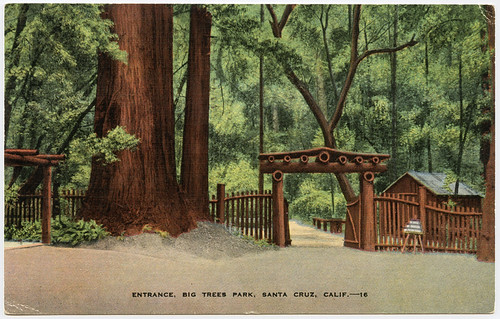
Before the north entrance to Big Trees Park, now Henry Cowell Redwoods State Park, was built by the county, entrance to the grove was either by walking over a swing bridge across the San Lorenzo River from the west bank, arriving by train at the Big Trees Station, or by driving across or fording the river itself.

2007-034-0006-web

In 1933, after the north entrance was competed, the south entrance was closed. This was not a popular move. Passengers arriving by train had to "look through a wire fence as if looking into some kind of a cage and then go away dissatisfied."

Winfield Scott Rodgers, former editor of the Mountain Echo newspaper was among many who complained. Rodgers was expecting to be able to drive through the park from the north to the south entrance but was met by a "high stockade made of rustic redwood" with a gate barring entrance to the grove. He was informed that automobiles were no longer allowed to enter or pass through. He wrote:

All who may desire to see these marvelous growths, when the sun is low and the days are short, must leave their comfortable cars and, at the risk of catching cold, trudge through the damp, frosty air and over the cold, damp soil...

He expressed the concern that those too frail through age, illness or disability would be prevented from seeing the wonders of the park without a hardship "too great to make it worth the cost."

Owners of businesses located at the south entrance were not happy either. George Hopkins who owned the adjacent grove on which the Big Trees Station was located was furious as passengers getting off there would have to walk "several miles" around the park to the north entrance instead of a walk of just 300 feet. The Southern Pacific Railroad Company were not happy either!

2007-034-0017-web

The Santa Cruz Sentinel pointed out that since the park was "buried in one corner of a county that has no state highway near it" there should be a loop through the park connecting to the San Lorenzo River Drive at both ends. Highway 9 would become a state highway the following year in 1934.

The reasons the county gave for closing the south entrance were as follows: 

  1. The park would have to hire an additional person in the winter and two in the summer to man the entrance;
  2. During the winter months the road, which crosses the river, would likely be impassable due to flooding;
  3. The road was actually over private property and might in the future be subject to litigation; and 
  4. At the north entrance two properties had been leased, one as an artists studio to sell art and redwood novelties and the other as a restaurant concession.
These properties, mentioned in the fourth point, were leased to artist Luther DeJoiner and restaurateur and former Brookdale Hotel and Brookdale Inn owner/manager Mary Shier respectively. The county would receive part of the profits of these businesses and the lease agreement was executed with the understanding that the south entrance would be closed.


The Big Tree Christmas Outdoor Lighting Association

Around 1927, Clarence F. “Sandy” Pratt of San Francisco decorated a tall evergreen tree in his garden on the edge of the Sutro Forest. After...