Tuesday, September 22, 2026

Felton Toll Gate House

In 1870, Feltonite Otis Ashely complained in a letter to the Santa Cruz Sentinel: “We have a county grog-shop at the toll gate on the San Lorenzo Road. We would inquire what runs that institution? The Supervisors compel us to pay one hundred dollars a month for a man to oversee the road and keep the toll gate. Now where do the proceeds of that grog-shop go? Do they go into the county treasury, or do they go to help repair the road, or do the people of the San Lorenzo Valley have to pay one hundred dollars a month for a man to take charge of the roads and at the same time keep a grog-shop, and put the proceeds into his own pocket.”

Tolls collected averaged around $400 per month, so after paying the toll collector, Eben Bennett, there was barely sufficient to adequately maintain the road, which needed constant repairs in the winter, and sprinkling with water in the summer to keep the dust down.

2004-049-0002-web

Image: An early image of the Toll House, July 1, 1890, when it was being operated by Charles Hartman. Charles is in the center of the image. James Hartman Collection, San Lorenzo Valley Museum.

In his obituary in 1904, Santa Cruz pioneer and millman George Collins is credited with building the section of the road [from the new town of Felton] to Big Trees around 1867. His lumber mill was just south of Felton near Gold Gulch and he needed to ship his lumber over the Graham Hill Grade. This section of road was not well travelled until the turnpike to Santa Cruz was completed. He is also credited with erecting the Toll Gate House.

In September 1872, the Toll Gate House was purchased from John Hagar by H. F. Beckmann who enlarged and updated the premises. He also stocked it with choice wines, cigars, and other refreshments and supplies to cater to picnic parties, hunters, fishermen, and campers. A new road to the Big Tree grove was built that turned off near the toll gate. Visitors to and from the grove were encouraged to visit the Beckmann House for “information.”

In November 1872, it was announced that the road would no longer be a turnpike, the toll gate would be removed and that the county would take over maintenance of the road. “We congratulate our citizens and teamsters on the removal of this tax; it was an onerous burthen [sic] and should have been abolished long ago.”

However in 1876, a franchise to the road was granted to John Shearer and John Mahanney for two years, provided they did not increase the rate of tolls over that collected by Eben Bennett.

The toll gate house continued to be operated as a saloon and later as a resort with rustic cottages and tent cabins.

From the early 1900s to the 1930s seems to have been a tumultuous time at the Toll House. The ownership and management of the business changed many times, sometimes multiple times in a year. Each time the liquor license had to also be transferred until in 1915, the transfer to Florence Ruth Silbery for the re-named “Big Trees Entrée” (a name that did not stick) was denied. However, that did not stop her and in September of that year she was arrested, and charged with selling liquor without a license, for which she paid a $50 fine.

In 1924, during prohibition the Toll House, now a café, was raided by federal officers, a quantity of liquor was seized and Joe Shaska and Harry Lusk were arrested and taken to San Francisco for violation of the prohibition laws. Lusk was acquitted but Shaska did plead guilty to one count of possession of intoxicants; he was fined $500.

2005-037-0063
Image: The Toll House circa late-1920s. Denise McMillian Collection, San Lorenzo Valley Museum.

The ownership of the café passed to Mr. and Mrs. E. Emlay who specialty was real Spanish dishes. It was Toll House owner W. H. Nidever, who in 1932 erected 10 rustic two room cottages with garages, to create the Toll House Resort. By 1952, there were 14 units. In 1963, cabin no.1, the first cabin to be built, burned to the ground. The old rustic cabins have since been replaced by new cabins but on the original sites.

There have been many locally renowned operators of the resort, George Featherston and Otto Holm to name just two. And others from further afield. In 1935, it was known as Lloyd’s Toll House Resort operated by Lloyd Boyea, son of prior owner Oliver Boyea, whose wife, Leonie, was reputedly a better shot that most men!

Over the years as a resort, visitors have returned time and time again often requesting their favorite cabin. Was the resort ever a brothel? We may never know. Certainly long time residents of the area believe so.

As the gateway to Big Trees the resort was ideally located. The private road that led to Big Trees adjacent to the resort was owned by the F. A. Hihn Company. Visitors would ford the San Lorenzo River from the west to the east bank to enter the Big Tree Grove. When, in 1933, the new north entrance to the park was completed, this south entrance was closed. This must have affected business at the resort.

It was 1952-1978 owners Wilbur and Anabelle Oliver that put a false front on the Toll House building to modernize it. This has since been removed. The property was subsequently marketed as an investment property and just before the 1989 earthquake the property was purchased by current owners Larry and Trey Noon of Blackburn and Noon Property Management.

Later that year the Toll House housed an antique store, owned by Bill Castor and managed by Sharon Phillips. The store closed just two years late in 1991. 

The Toll House or Toll House Resort Motel was designated a California Historical Resource in 1993 as a Point of Historical Interest.


Monday, September 21, 2026

Brookdale Ghost Stories

Let us look at the early history of the Brookdale Lodge, consider the validity of the ghost stories and examine some pretty awful deaths that happened in the waters near the Brookdale Lodge. None of them however, involve a Logan. No Sarah (she is made up) and no Gladys (she died in 2006 in San Diego).

In May 1903, it was reported that the “famous summer home of the L[afayette] F. Grovers, is being enlarged and added to, and will be converted into a boarding house.” Lafayette Grover was the son of lumber baron Stephen Frealon Grover, reputed to be one of the first white men to enter the Yosemite Valley. The Grovers had had a lumber mill just north of Brookdale at the end of what is now Camp Joy Road. In Stephen’s 1907 obituary, it reports that the Minnehaha summer cottage was the first in Brookdale. Enlarged, the cottage, then called the Minnehaha Hotel, could accommodate around forty guests and had a “well lighted wing for a dining room.” 

Its new owner, Judge James Harvey Logan, was to increase the hotel’s accommodations by building cottages on the grounds. The boarding house was to be run by Miss “Gussie” Heubeling. From 1904 to 1905 an advertisement ran in the Oakland tribune touting Brookdale’s virtues. “No business, no trade, no liquors. White sulphur springs; Electric lights; sanitary sewerage; 3 trains a day each way.” Hotel rates were between just $9 and $12 per week and cottage sites were available with building restrictions for “selected people of the better class only.” Actually, the sewer outlet was just a rocky barren spot on the east of the San Lorenzo River a short distance south of the town. Clear Creek was the source of the electric power; water from the creek being drawn by an eight-inch pipeline to a large Pelton water wheel and dynamo.

In 1905, the hotel changed its name to the Brookdale Hotel (later to be the Brookdale Lodge) and in 1911 it was purchased by Judge William Mack Aydelotte, a Santa Cruz lawyer and president of the Santa Cruz Emporium, who leased the hotel to Mrs. D. S. Fairlee. In 1913, Mrs. Fairlee applied for a liquor license – Brookdale was changing!

Judge Logan's wife Catherine had died in 1909. Although they had no children, a niece and nephew, Josie and Herbert Turcot had resided with them. Judge Logan remarried in 1910 to Mary Couson who bore daughter Gladys in 1911. 

In 1921, William and Mary Shier of Stockton bought the Brookdale Hotel. Mary Shier was close friend of Sheehan family, Logan's niece Josie and her husband. The Sheehan's daughter, Alice "Logan Berry Jam" Sheehan as she was affectionately called, owned the parcel across the street from the Brookdale Hotel that would become the site of the Brookdale Inn - more to come on that story in another blog post!

Mary Shier ran the hotel for a couple of years until it was sold in 1923 to Pasadena capitalist Foster K. Camp. Camp would create “A Mountain Lodge with Nature Brought Inside,” – The Brookdale Lodge. The Shiers signed a five year agreement with Camp to stay out of the resort business.

So, by the time Camp had built his famous dining room, Logan's daughter Gladys was 12 years old and they were living in Oakland. 

2012-034-0014
Image: Brookdale Lodge Collection, San Lorenzo Valley Museum.

Now let us back track to 1912 for a horrific tale with the makings of a ghost story.

Tragedy in Brookdale

It was an exceptionally hot day in July 1912 as two teenage friends, Gladys Hawkett and Lillian McDonald of Oakland, enjoyed their summer vacation in Brookdale. They were staying at "Tekwah," the Brookdale summer cottage, of Joseph and Emma Sills also of Oakland, on Clear Creek, the creek that runs through the Brookdale Lodge. Together "they donned their bathing suits" and along with Gladys' sister, Mrs. May Cripps and her two children, William aged five and Dorothy aged six, they ventured to the public swimming hole. Gladys had written to her mother "that she could swim six good strokes."

The girls could not swim, so after "sporting around" in the water for a while they decided to find a more secluded spot to practice their strokes. The entire party walked down stream. Mrs. Cripps and her children walked along the bank of the San Lorenzo River, while Gladys and Lillian walked along the river bed.

Mrs. May H. Cripps Goes to
Death in the San Lorenzo River,
Oakland Tribune, July 16, 1912.
Then tragedy struck. The girls stepped off a shelf in the river into a pool at least fifteen feet deep. Unable to swim they quickly began to sink. Watching them from the river bank Mrs. Cripps must have been frantic. She could not swim either. "Bidding her children to remain on the bank she plunged into the pool." She too began to sink.

On the river bank Dorothy and William witness this awful scene. First their cousin, her friend, then their mother, consumed by the San Lorenzo River. They screamed and waded into the water. Their cries so loud that rescuers were soon on the scene. But alas too late.

It took over twenty minutes to pull their bodies out of the water, using rakes, and up the slippery bank. Their rescuers were Charley Hall who at the time was working on the Wright property adjacent to the hatchery and the river, and Harry Nehf, the assistant at the Brookdale Hatchery. Hall, Hehf, and Welden Conklin of Santa Cruz carried the bodies up the steep hill to the hatchery where a team of three doctors, Dr. William Caesar of Boulder Creek, Dr. W. O. Smith, and Dr. E. R. Campbell of Oakland, tried valiantly to resuscitate them.

Just a few days earlier a six-year-old girl named Mary Corbett had been rescued by a ten-year-old boy, Leslie Short of Berkeley. Mary had been paddling in the river at Brookdale when a current caught her and started to carry her down stream. If not for Leslie, the young girl too might have become a victim of the river. Her father rewarded Leslie's heroism with a "shining $10 gold piece."

Danger notices to be placed along the river banks between Boulder Creek and Ben Lomond were called for as a "matter of life or death." "Danger! The water here is 15 feet deep."

Thursday, September 17, 2026

Beedes' Museum

Tucked behind the current Sew Rose building on the corner of Highway 9 and Mill Street in Ben Lomond is a little cottage. In 1940, Willoughby A. Beede, a mining engineer, owned both the cottage and the Sew Rose building, which housed the Ben Lomond telephone exchange. He and his wife Elizabeth, who was the manager of the Ben Lomond telephone exchange, which was located in the now Sew Rose building, opened a small museum in the cottage. 

2022-001-0018f-web
Image: Robinson Collection, San Lorenzo Valley Museum.

The Beedes wanted to be able to show the public their “fine collection of Indian relics, and trophies gathered from all parts of the world.” The collection had been gathered from Western Canada to Mexico City and the Pacific to the Great Lakes. Two pottery pieces were reputed to be 2000 years old.

The collection included Native American baskets from fifteen different tribes. All old and representing the “excellent craft[wo]manship” of the various tribes. Author and historian Geoffrey Dunn, who was a young boy when the museum closed down, recalls, "… being very overwhelmed by the beauty of all the baskets, the place seemed magical to me…"

In addition to the museum, the building also housed a souvenir shop and lapidary, since as a mining engineer working in “many parts of the world,” Beede had collected copious amounts of wonderful rocks and gems.

Beede, who had come to California around 1928, co-owned “Ye Old Book Shop” on Pacific Avenue before moving to Ben Lomond. In 1904, while employed as an engineer for the Standard Oil Company, he went to Alberta to work with the Sarcee tribe, now known as the Tsuu T’ina Nation. The wife of the chief of the dance had had an accident and could not move, a government doctor had deduced that she had broken her back. Beede, who had studied first aid, was urged by her husband to examine his wife. He determined that her hip had been dislocated and was able to put it back into place. Pleased with the outcome, the chief made him his blood brother in a wrist-slicing ceremony.


Wednesday, September 16, 2026

Buy a Farm at Boulder

0.306-web 
Image: Christian Horstman displaying fruit from his Boulder Creek, California farm at a fair. San Lorenzo Valley Museum Collection.

(Extract) by Truthful James

I'll tell you of a town, a place of great renown,
'Tis the liveliest and best in all the earth;
Where the people all are clever and they almost live forever,
For their lives are filled with jollity and mirth.
Talk of every lovely Eden, from the Southern Cross to Sweden,
Vale of Cashmere, Spain or Naples, new or older,
There is one excells [sic] them all, like the fair belle of the ball,
'Tis the celebrated mountain town of Boulder.

We have climate fine and rare, and the rich and perfumed air
Gives us rosy cheeks and tempers of sweet-savor,
For 'tis full of pure ozone - and it always rains cologne,
Which gives our fruit its most delicious flavor.
'Tis of size unknown before, for one peach will feed a score
And the peach stones make good cord wood when 'tis colder;
Then our prunes are not so little, for each one will fill a kettle,
Say, don't you want to buy a farm at Boulder.

In our fields the hay crops stand, twelve feet high on every hand,
Smelling sweeter that the tropic isles of spice,
And the cows that roam the scene, always give down pure ice cream,
And the boys and girls all think it very nice.
The chickens always lay half a dozen eggs a day,
All of purest breed and double yolks I'm told-er
If you doubt it, just you try, for "I cannot tell a lie,"
Just come and buy a little farm at Boulder.

Mountain Echo, December 29, 1906.

Married Men Versus Single Men

In 1911, a baseball game with larger-than-life legends was captured in cartoon form in the Mountain Echo newspaper by caricaturist Parker. A neighborhood baseball game was played on the diamond at Harmon Park, a quarter of a mile north of Boulder Creek. 

The day was perfect for the Easter game, which was well attended by “Society” as was demonstrated by the display of Easter millinery which rivaled that of San Francisco! It was here that the Married Men suffered a “heartbreaking defeat” against the Single Men.

As they played the Married Men’s wives shouted their encouragement and when a play was made by one of the “eligibles,” the “giddy young debutantes” in attendance answered in chorus.

However, if the first inning had been different, the score would have been a tie. One of the first balls pitched by “Cannonball” Cottle for the Married Men broke rival teammate Billie Ritchie’s finger and while the injury was being evaluated the Single Men had trotted over the home plate no less than 8 times.

Winfield Scott Rodgers, editor of the Mountain Echo who played at third base for the Married Men was characterized as always there, except when needed. Postmaster Dan Trout, in right field, apparently had nothing to do but catch flies, and Town Trustee Joseph Mello’s fingers were described as buttered.


Tuesday, September 15, 2026

The Enduros

As far back as the early 1900s the San Francisco Motorcycle Club ran Enduros – motorcycle endurance races.

In 1916, two of the participating riders were arrested for speeding on the Santa Cruz –Watsonville road during the run. They were each fined $5.

In 1919, the run was to be “the greatest motorcycle endurance run ever put on in California.” The run was to be the big sporting feature of Washington’s birthday. The motorcyclists were to make two round trips on the Saturday and two on the Sunday over a course from San Francisco, down the narrow, treacherous wagon road along the coast to Santa Cruz, then over the mountains to Los Gatos, and back up the peninsula. Twenty-seven riders took part and Lores Alzina, cousin of Santa Cruz Deputy Sheriff Enoch Alzina, won first place with a perfect score. It took three hours and forty minutes for him to drive down the coast. The road between Pescadero and Santa Cruz was described as “very heavy” and the going “very sloppy.”

By the 1950s, there were four Enduros being run in the Santa Cruz Mountains: 1) Frisco Enduro 2) Tin Hat Derby San Jose 3) Palo Alto Yellow Jackets 4) Santa Cruz Stunt Jumpers (Stumpers).

As many as 40 to 50 riders would compete in the 120-150 mile events starting from their clubhouse and riding up into the mountains and out to Pescadero on a maze of fire roads, old wagon roads and trails that wound around the Big Basin State Park area. These events were always run in the winter months. The more rain – the better.

The noon checkpoint was always Boulder Creek, a one hour stop for gas, food, and rest before going back out to finish the event.  

L2017-019-001-adj

Image: Pictured in Boulder Creek outside Boulder Burger is Stumper Keith Cornick on his BSA Gold Star Motorcycle. Keith was the winner of the 1958 Yellow Jackets Enduro. San Lorenzo Valley Museum Collection.

From 1955–60 Keith competed in most of the Enduros, but by the early 60s the roads and trails were being gated by State Parks and private property owners and the Enduros stopped being held here in the Santa Cruz Mountains.

In 2017, Keith Cornick participated in the Home Town Teams exhibition at the San Lorenzo Valley Museum, and shared the Enduro story. At the time he still lived in Santa Cruz and at the age of 85 still rode an off-road motorcycle. He passed away in 2019.


In 1903, a remarkable young man opened a summer camp for the Boys’ Brotherhood of East Oakland. He was just 21 years of age and would go on to become an authority on the upbringing of boys, lecturing all over the country. 

The problem, as described by George Ellingwood Joy, was “that ordinary man is so wrapped up in making a success of his business, so intent upon the pursuit of the almighty dollar, that he has no time to devote to the simple things in the boy’s life.”

The Reverend Joy also managed Camp Joys in San Bernardino, until in the spring of 1909, the Boys’ Brotherhood there decided to disband.  Joy, however, was also an advisor to the Boys’ Brotherhood of Sacramento and it was for this organization he organized a summer institute on land owned by his father just south of Boulder Creek on the east bank of the river in the summer of that year.

The Sacramento club was the largest west of Chicago with almost four hundred members. For fifteen days in late July 1909, about forty boys from the club, ranging in age from nine to eighteen, stayed at Camp Joy. They were accompanied by a number of their parents who stayed in nearby resorts.

A large open-air pavilion seating four hundred was erected in one of the groves for entertainment and as an open-air dining room. The sleeping quarters were “in a most picturesque location,” being located in eight tents on large platforms that were built over the river.

In 1910, the railroad company established a flag-stop at the camp.

In 1911, the ninth season of the camps, a thirty-two-page brochure describing the Boulder Creek location was published. Besides the activities and outings available to the boys such as boating, swimming, photography, a dramatic club, athletics, culinary, workshop, reading … to name just a few, there was also a treasure hunt. With the goal of “education through play,” each new boy is given a description of the exact location of where the treasure was buried in a prior year. This encouraged him to “observe nature so closely that he unconsciously becomes clever in his knowledge of the woods.”

Image: San Lorenzo Valley Museum Collection, 2003-085-0050 (Scanned Document), 1911, Athletic Bars and Rings – The Boys at Play.

Now the camp ran from the end of June for two months. A boy could stay the whole summer ($80) or just three weeks ($35). For just an extra five dollars a boy could be part of a three-day excursion to Yosemite, all expenses, including hotel accommodation, included.

After the camp ended, Rev. Joy too returned to his home in Sacramento and the resort remained deserted until the following year.

Over the subsequent years Joy founded a home for young men in Sacramento, and lectured profusely. His talks were often attended by hundreds. The camp was reportedly was sought after by many for a Boy Scout camp, but eventually it became the home of Elihu Huntington. After his death it passed to his daughter Cressie, who was born on the property. In 1971, Cressie had the property re-zoned from single-family-residential to residential-agricultural and allowed the Camp Joy Garden Project to use the land. She and her family members “wanted the land turned into a garden to preserve older values that have been lost since the American public became urbanized.” 

Today, Camp Joy Gardens is a small, organic family farm that is run as an educational non-profit organization. You can learn more at www.campjoygardens.org.


The War to End all War

One of the first men in the Valley to enlist after the US joined the World War I in 1917 was Henry S. Aram. He enlisted prior to the registration that would result in the draft, with the Army Signal Corp. Being one of the first, Aram was placed on the Honor Roll. In a letter published in the Sentinel in 1918, he describes life in the trenches: "After you get used to hearing a shell say LoooooOOOOOU and then hear it explode and not hit you, then all you have to do is sit tight and wait for the next one to sing the same song . . ."

Although Valley men were injured overseas, none lost their life. Herbert Hartman of Boulder Creek was badly injured; Hartman would serve as the Boulder Creek postmaster in the 1940s. 

To signal that the train was carrying returning heroes, the engineer would tie the engine whistle so that it blew all the way between Felton and Boulder Creek. When Archie Hagerman and Fred Hess arrived home it was reported that half of the population of Boulder Creek were at the depot to welcome them. 

WWI Collage

Image: San Lorenzo Valley Museum Collection. Men from the San Lorenzo Valley who served in WWI. 
Bottom Left: Stanley Horstman. Top Right: Archie Hagerman. Bottom Right: Frank Walter.

Stump Town

After the redwoods were felled, the stumps would need to be removed, often to be replaced by an orchard. The stumps were blasted out using an auger to get the powder or dynamite deep into the root system.

In 1936, the sixty-year Valley resident Francis Hughes recalled how in the 1880s Boulder Creek was also referred to as "Stump Town." She recalled that before the railroad came there were "42 stumps in the center of town, the giant redwoods having been felled to make room for the buildings."

In 1937, Winfield Scott Rodgers, former editor of the Mountain Echo newspaper, recalled during a talk at a celebratory dinner "where the town now stands was a primeval forest and at one time was called Stump Town due to all the stumps remaining where the timber had been felled. The main road wound around the stumps and crossed the river where the bank was lowest," at which place the river was forded.

Indeed, downtown stump removal began slowly in 1885, the year the railroad arrived in Boulder Creek. In May 1886, a "grand exhibition " was held in the Washingtonian Hall to raise funds for "exterminating the stumps that throng our thoroughfare." The hall was decorated with ferns and the stage with flowers, ferns, beautiful pictures and cages of canaries. The performances included a sketch entitled "Remove the Stumps" where a miniature stump was placed on the stage and two laborers were "engaged with pick and shovel, toiling and sweating to remove the same."

Just a few days later stump removal began in earnest. In August, it was reported that the "booming of [dynamite] blasts can be heard here at all hours of the day. Cause -- the blowing up of stumps." In December 1886, it was reported that the removal of stumps continues, streets were being graded, and cottages, shops, barns, and sheds were being constructed. 

This image circa 1908, from the San Lorenzo Valley Museum General Collection, is of a huge redwood stump that stood where the Boulder Creek Methodist Church now stands on Boulder Street.  Hack Huddleson stands at the top with Harry Pierce on the left and Willis Horstman on the right. The girls are (left to right) Helen, Mable, and Dorothy Johnson. Mable died shortly after this photograph was taken. 

2003-XXX-0089-web

San Lorenzo River Goes on a Rampage

When we recall disastrous floods in the San Lorenzo Valley we think of the horrendous life taking floods of ’55 and ’82. But both flooding and the inevitable ensuing mudslides are a recurring theme in the history of the Valley.

In the winter of 1940, it rained and rained. Overflow from the reservoir above the town of Boulder Creek brought down a torrent of water. The torrent moved a log jam sending a cascade of water flooding into the town.

2013-020-0014c-web
Image: Pilger Collection, San Lorenzo Valley Museum.

The sudden rush of water damaged streets such as Pine which was piled high with debris of mud, rocks, and timbers. A grader found it impossible to travel though the area and ended up stuck in the rubble. Homes were abandoned and Boulder Creek’s hotels were “packed to capacity with refugees.”

2013-020-0014b-web
Image: Pilger Collection, San Lorenzo Valley Museum.

There were at least five slides along Highway 9, with the Blue Slide between Brookdale and Ben Lomond and a slide at Glen Arbor being the most dangerous. Power and telephone lines were down between the Valley and Santa Cruz, and Ben Lomond residents were without water for four days when the wooden pipe serving the town from Marshall Creek failed. Residents hauled water from the town’s stores and private wells.

Leslie B. McBride had to use pack mules to get feed to his hundreds of chickens on Love Creek.

The Brookdale Lodge suffered major damage, though excess water in the creek though the dining room was averted by automatic flood doors at each end of the building and so prevented what could have been a disaster for the renowned resort.

Of the river resorts, Paradise Park, Gold Gulch, and Felton Grove were the worst hit with some property so badly damaged it would need to be abandoned. The route from San Francisco to Boulder Creek along Skyline was open on the day after the worst flooding and it was reported as “heavily traveled by valley summer residents who rushed down to view [their] damaged property.”

Storm damage was suffered throughout the county and neighboring areas. Big Creek State Fish Hatchery, which was established in 1926, was closed as a result of the damage by the storm, the eggs being moved to the hatchery at Brookdale. Though storm damage was a major factor in its closing, another, just as important, was the inadequate water supply of the prior years. 


The Oldest Inhabitant

On the corner of Brookside Avenue and Love Creek, Ben Lomond, stands this ancient giant redwood. The tree, whose trunk was too distorted to warrant felling when Love Creek was logged in the late 1800s, was spared and still stands today.

2022-001-0007
Image: Robinson Collection, San Lorenzo Valley Museum.

Gloriously twisted and gnarled this distinguished tree was pictured on postcards, such as the one shown here. This postcard, among others of Ben Lomond, was produced exclusively for William H. Nicholson, the then postmaster of Ben Lomond. He owned property on Love Creek. The tree was also depicted in the San Francisco Chronicle, 1915, in a full-page article on Ben Lomond and its surrounding area.

Once scorned by lumbermen, crooked and twisted redwood timber was soon sought after by cabinet makers. It was aptly described in the Pacific Monthly magazine: “The grain of “curly redwood,” when polished stands out in exquisite shadings, showing its silken lines as clearly as if a wood-nymph’s wavy tresses had been perpetuated in the tree.”

Oakland locally renowned artist Charles R. Hall, who moved his art gallery to Main Street, Ben Lomond in the mid-1930s, found a very unusual specimen of redwood on Love Creek in 1932. The specimen was described as a “knot” rather than a burl and in 1935 was described as “the only piece of its kind ever discovered.” It was growing on the remains of a tree that had been felled many years before.

The knot, which weighed over three tons, had a diameter of nearly five feet, and was big enough for fifteen large tables, did not resemble redwood in composition. Because of the “tigerish” stripes which waved through the wood, Hall referred to it as “Tiger Redwood,” and sent samples to many wood experts for analysis, who were evidently baffled. A table made from the Tiger Redwood was exhibited at the state fair in Sacramento in 1935 where it won a gold ribbon. Hall was reputedly offered $10,000 for the table, which he refused.

In 1936, Hall received three gold medals for his work at the state fair, with the curly top Tiger Redwood table taking the highest award. The tabletop was described as resembling red and white streaked marble.

Hall also named another distinct type of redwood, “Tuskin Redwood.” A burl of this was found in the river bed when new concrete pier foundations were dug for the bridge at Dickenson’s Hotel (at the south end of Ben Lomond).

An example of a curly redwood chair and picture frame can be seen on exhibition at the San Lorenzo Valley Museum.


Linden Park

George Linden arrived in Boulder Creek around 1892. He secured employment with the Southern Pacific Railroad as a laborer. At the south-east end of the railroad yard, close to the round-house, the land sloped steeply to the river. It was a wilderness, overgrown with thick brush and covered with rocks. George asked the railroad if he could lease the land and build himself a small cottage – they agreed, since the land was useless to them.

Linden Park
Boulder Creek, 1908.
George began to clear the land, build himself a cottage out of driftwood, and decorate it with natural elements he found on the property. Each day he toiled, before and after work, sometimes by moonlight. He laid out winding paths, built walls and terraces with the rocks, and planted flower beds. The rocks were carried up the steep incline on his back using a harness he had constructed.

Initially, George carried water for irrigation up the slope from the creek by balancing two kerosene cans on a pole, but the townspeople were so thankful for the park that they established a subscription fund to raise money to purchase material to pipe water for irrigation. Local businessman Henry Middleton, owner of the Boulder Creek Water Company, was so impressed with George’s amateur gardening that he told George he was “welcome to all the water he could use.” He built a fish pond, a throne, and picnic tables, and he fashioned arbors from driftwood on which roses and grapevines climbed. For the ladies who like a cup of tea, he built a Dutch fireplace of boulders and mud with a chimney which was once a sewer pipe. A tea kettle hung from a crane. He propagated violets, yerba buena, blue flag flowers, fleur de lis, wild strawberries, pansies, and hearts ease. He planted a row of willows along the outer edge of the park with a row of roses at their feet. He created a dozen “leafy bowers” with benches and tables from driftwood.

Around his cottage he built a cinder track. Thirty laps was equivalent to the distance of one mile and one could “try your speed as a pedestrian.” George “challenged the State for a walk in this track of ten to a hundred miles.”

On Wednesday July 10, 1901, his body was found in the San Lorenzo River in Boulder Creek. He had succumbed to a heart attack. His funeral took place in the park. It was crowded with townsfolk. Samuel Rambo, David Moncrief, Thomas S. Cleland, John Glass, Thomas Maddock, and Daniel Hartman were the pallbearers, and Reverend Michael A. McKey of St. Michael’s Catholic church officiated. A volunteer choir sang as George Linden was laid to rest at the foot of the four poplar trees, “planted by himself in the park, and which he had called his monument.” His grave was covered with ferns and flowers.

But George Linden was not his real name. Four days after his death it was revealed that George was in fact William Scott. William had been a police officer and a champion long distance walker, winning the diamond belt in a six-day contest in San Francisco. Charles Hain, Henry Middleton’s brother-in-law, had been a good friend of William Scott when he was in the police force. When visiting Boulder Creek, Charles chanced upon George, who requested that he keep secret the knowledge of his former life, to which Charles agreed.

2016-005-0278-K252 Linden Park, Boulder Creek-web
Image: Perry Collection, San Lorenzo Valley Museum.

Linden Park remained for many years under lease to the Boulder Creek Improvement Club. What little remains of it today is known as the “Barbara Day Park.”

This article is excerpted from Santa Cruz County History Journal Do You Know My Name? published by the Santa Cruz MAH which can be purchased in the San Lorenzo Valley Museum's bookstore. Read the full story to find out why William Scott changed his name and to discover more about the bizarre events that happened after his death.


His Hand on the Throttle

On March 30, 1907, Engineer William Robert Dow suffered a severe stoke while driving a Southern Pacific steam locomotive on his usual route between Santa Cruz and Boulder Creek. 

Earlier that day, Dow seemed in the best of health, but on the run home, just opposite Old Felton, he succumbed with “his hand at the throttle of the steel steed which he had driven and controlled so carefully and so well.”

Fortunately, Fireman McDaniels, while backing the engine from a slide where they had been working, noticed that Dow was unable to use his hand to operate the air-brake. McDaniels stopped the engine and Dow was taken to his home where he passed away shortly after. He was one of the most popular engineers employed on the run, which he had operated for the prior twelve years. 

Engineer William Robert Dow was the inventor of a new type of compound steam engine, that is a steam engine where the steam is expanded in two or more stages. At the time of his passing, this new engine was intended “to overcome the limitations of the present types in the service of the Southern Pacific Co.” He was also the holder of several patents for gas engines, all filed in the late 1890s, while he was living in the San Lorenzo Valley.

One of his gas engine patents, witnessed by Boulder Creek residents Billy Dool and Arthur Stagg, was cited as prior work in a patent applied for and granted to Major Frank Bernard Halford, a renowned British aircraft engine designer, in 1945, for the patent of a Jet Propulsion Plant. Halford's jet engine company was bought by the De Havilland Aircraft Company. Dow's patent has also been cited more recently, in 1976 and 1984.

The winter of his passing, 1907, had been a wet winter. The San Lorenzo Valley had suffered badly; storms and floods had wreaked havoc. Just a few days before he died, Engineer Dow was pronounced a hero. While transporting a train loaded with school children and passengers just south of Felton his keen eyes noticed the brush on the top of the mountain above Big Trees Park bend and “move slowly down the hill preceded by rolling stones which were beginning to strike the track and the train.” 

Quickly, Engineer Dow thrust the engine into reverse and not a moment too soon, “for with a thunderous roar the whole mountain side broke loose.” Five hundred feet of the track was buried in mud, rocks, and trees, to a depth of forty feet, and some of the tracks and ties were thrown into the river below. But the train, and all of its precious cargo, although damaged from the pelting of rocks, were saved.

But even worse weather was to come. The storm on the night of March 23, 1907 saw forty mile an hour gales; the San Lorenzo river rose four and a half feet, and all five of the bridges crossing the river in Boulder Creek were completely swept away, carried by masses of drift material. Roads were impassable with slides and washouts. It took days for the debris to be cleared and it was while clearing one such slide our hero, Engineer Dow, was taken.


1993-XXX-0011-web
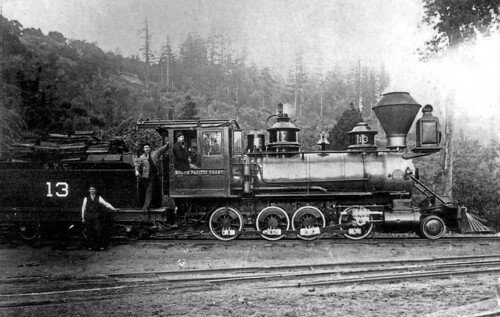
Image: General Collection, San Lorenzo Valley Museum. Narrow Gauge South Pacific Coast Engine No. 13, 1895. Engineer William Robert Dow at the throttle, fireman Henry F. Clouette standing in the gangway, and brakeman John Stots on the ground.

Sunday, September 13, 2026

Timber Days Fishing Derby

Here we have the new bridge over the San Lorenzo River on Irwin Way at what is now Barbara Day Park in the 1950s during a Timber Days Fishing Derby.

In 1956, 1000 competitors caught an estimated 2000 trout. Some of the trout had been tagged with a metal tag. If you caught one with a tag, you won a prize. 2002-002-0003
Image: Steve Sanders Collection, San Lorenzo Valley Museum.

The Blue Slide

Have you ever noticed, as you drive between Brookdale and Ben Lomond, those iron pipes sticking out of the hillside? That's to stop the Blue Slide.

The slide was so named because it was composed of blue clay. It was aptly described in 1937:  "Its special blue clay ingredient makes it dangerous and unmanageable." 

And for many years it was unmanageable, depositing tons of debris onto Highway 9 during heavy rainfalls, cutting off the towns of Brookdale and Boulder Creek.

In 1936, there was a determined effort to halt the "annual avalanche at the 'blue slide.'" The state highway crews were assisted by Works Progress Administration (WPA) crews to cut the hillside back. The debris and rock was hauled out and used in the construction of the final segments of the San Lorenzo Valley's new hiking and bridle trail between Felton and Boulder Creek, a project sponsored by the chamber of commerce and expected to serve "thousands of summer vacationists."

However, the work did not stop the Blue Slide. In 1940, more tons of debris from the slide was used by state highway crews to level off the highway near Brook Lomond and to level off the ground for a parking area at the park in Ben Lomond.

In 1941, the Blue Slide "took the greatest skid in its history" when it dumped a 300-foot "mountain" on the highway, along with trees and power lines.

It wasn't until 1970 that the slide was tamed. Granite Construction of Watsonville was awarded an almost $300,000 contract to repair portions of Highway 9 including the Blue Slide area. "Washed out highway sections and embankments will be restored, and bin-type retaining walls built. In addition, drainage facilities will be replace[d] and rock slope protection will be installed." The work, which began in January, had to be postponed when the rains began as, you guessed it, the rains washed out the repairs.

Work was completed in the summer of 1970. The Blue Slide was subdued but not completely harmless. Slides at that spot, though not as damaging as in the past, continue to occur.

2012-005-0004-web
Image: Eleanor Fraser Collection, San Lorenzo Valley Museum.

Saturday, September 12, 2026

Felton Covered Bridge Park

Imagine driving into Felton across the covered bridge. Before 1938, that was the county road. Signs, attached to the bridge, cautioned drivers of vehicles over 10 tons. “Every time a heavily-loaded truck crosses the covered bridge it gets spooky. It creaks, and groans and acts like it was about to pass all in.”

But that all changed in 1938, when it was replaced by a modern concrete and iron structure. Now, bypassed and just used for foot traffic, the bridge stood between two sections of county road to nowhere. First the bridge was to be taken down, but the community rallied and San Lorenzo Valley Property Owners Association member Theodore Smith suggested that the club sponsor a move to create a Felton Covered Bridge Park and discussions to make the roughly six-acre area a State Park ensued.  The proposed park would include the bridge, the county road from Felton to the bridge and the triangular piece between the old and new Mount Hermon roads. 

The bridge fell into disrepair and in 1947 the San Lorenzo Valley Chamber expressed interest in its restoration, but they would need help from either the county or other local entities. The estimated the cost of repair was $750, but just two years later it was realized the cost was going to be more like thousands instead of hundreds. 

The bridge was severely damaged during the 1955 floods and in 1956 the County spent $2000 on repairs. Then supervisor Vince Locatelli said “the money was wasted because people did not appreciate it.” According to the Sentinel, people would take parts of the structure to use as firewood. This spurred Alice Earl Wilder, Valley Chamber secretary and local historian, to propose applying for State landmark status in 1958, a move supported by the Board of Supervisors, the San Lorenzo Valley Chamber of Commerce, and the San Lorenzo Valley Property Owners Association.

Then in 1960, Felton’s volunteer firemen, through an agreement with the County, made the restoration of the bridge their project, with Fire Chief Ted Toft leading the effort. It was their hope that the County would agree to “establishing a small park on the land with a picnic area and restrooms.”

It was Fire Chief Ted Toft’s idea to hold annual bridge breakfasts to raise the necessary funds for the restoration and in 1960, $800 was raised and used to refloor the bridge. Often a gymkhana was held in conjunction with the breakfast and in later years the Race though the Redwoods and fine arts festival. The breakfasts ended after the devastating storms of 1982.

Although revived in 1989, funds from the breakfast would now benefit town improvements in general. Between 1982 and 1987 the County undertook a $750,000 phased renovation of the bridge. 

In 1987, a town plan prepared for the County Board of Supervisors by architecture and community planning firm Jeff Oberdorfer & Associates along with extensive community input envisioned a park on what was now called the Felton Commons. The renovation had ushered in a new era for the bridge, in Oberdorfer’s words: an era of “town pride rather than vandalism.” Among the goals identified by the community workshops for the project was protection of views of the National Register listed Covered Bridge. The land, now in private hands, would need to be purchased. It was noted that the “entire parcel is within the 100 year Flood plain and most of the parcel is within the Floodway - rendering the parcel unbuildable.”

In early 1991, further workshops, hosted by the County of Santa Cruz Parks and Open Spaces and Cultural Services were held with the goal of refining the conceptual plan for the park. By September a draft master plan was ready for a public hearing and the plan was approved by the Parks and Recreation Commission later that month. It was noted that “no permanent structures can be built in a flood plain” – hence no permanent restrooms.

In 1992, the park received additional funding, allowing its construction to be substantially accelerated. Supervisor Fred Keely stated: “We’ll be able to showcase the jewel and crown of the San Lorenzo Valley, the Felton Covered Bridge. Now your eye will be drawn to it over this expanse of parkland.”

Ground was broken in March 1992 and volunteers from the community were encouraged to help with the construction. Landscape planting began in October with landscape architect David Broce coordinating the process. The plants selected were native drought-tolerant or riparian species.

The park officially opened on Sunday December 6, 1992. At the ribbon cutting, Felton residents John Masterman and James Bricken were credited with spurring the efforts.


McKeen Motor Car Kills Woman

Pictured here, around 1910, is a 6-cylinder gasoline powered, McKeen railroad motor car. The cars were manufactured in Omaha Nebraska. Unfortunately, the McKeen engines struggled with the grade of the railroad track in the Valley, and their use was soon discontinued. The cars featured unusual porthole style windows which were a McKeen trademark.

In June of 1910, a terrible accident happened on the railroad bridge at “death curve” just south of Boulder Creek. It was the last railroad bridge before the town and had a sharp curve preventing the driver from seeing more that 60 feet ahead.

The Garretty family were on their way to visit friends, the Winkleblecks who lived on the east side of the San Lorenzo River, and were on the trestle bridge that crossed the river when a motor car approached. They seemed to have forgotten the railroad timetable. The father and their three children were walking ahead, the mother behind. As the car approached the rush of the water below drowned the noise of the engine. Her husband shouted to her but in vain. The wife was killed instantly and the children were hurled to the ground.

The bridge crossed the property called “Lachesa”, the summer home if A. M. Anthony. He and a Mr. and Mrs. Ascher of Berkeley rushed down to pick up the injured children. At the inquest the verdict delivered was accidental death; the driver was exonerated, but the railroad company was severely admonished for not providing the motor with a heavy-duty whistle.


Image: The Felton Volunteer Firemen Present This ... Commemorative Issue 1892 - 1967, San Lorenzo Valley Museum.


A bit of history about the cars from Railroad Street.

Wild Attractions

 In the early 1900s, the wildlife of the Valley was considered a magnet for tourists. In order to attract additional visitors, non-native wildlife was introduced. In 1911, twenty-five turkeys were delivered. It was hoped that these birds would prove to be a successful and attractive feature and that a new sport would be created for hunters. 

In 1914, as part of a government program to revive the California tule elk population, ten elk from the Miller and Lux Reserve were introduced into Big Basin. 

California Fish and Game, 1914.

Tule Elk, a distinct subspecies of elk found only in California, were thought to have been extinct in the 1870s, but in 1874 a pair were discovered on the ranch of Henry Miller in the Central Valley and his protection of the pair is credited with the survival of the subspecies. An additional four arrived in the park in 1915. 

By 1916, three of the elk, including the finest in the herd, had been killed and a reward of $100 was offered to anyone who could provide information that would lead to an arrest. It was difficult to keep the elk constrained in their coral and they wandered quite far. In October 1916, an elk was spotted twenty miles up the coast, on the Gianoni Ranch, feeding in a meadow with a herd of cattle.

In 1920, a single elk from a herd of forty in the Del Monte Forest was transported to Big Basin. The entire herd was to be moved to other locations because of the havoc they were causing to Pebble Beach homeowners' gardens. Eventually the Big Basin herd died out.

In the late 1920s and early 1930s, a dreadful disease struck the Valley's grey squirrel population. The disease left the animals blind and unable to find food. A year-round hunting ban was put in place and by 1933, it was believed that there were none left here. In 1937, pioneer conservationist Herman Irwin for the San Lorenzo Valley Chamber of Commerce, surveyed the squirrel population and found just fifteen individuals, none south of Ben Lomond. The chamber was eager to see the population revived to provide an attractive feature "for the strolling visitors and vacationists."

In March 1940, five grey squirrels were imported from Montana and in May, three pairs of "healthy balls of fur" were delivered to Warden Powell for Big Basin State Park, where they promptly chased the only known native "high into a towering redwood tree."

In 1935, the then president of the San Lorenzo Valley Chamber of Commerce, Frank Pimentel, investigated introducing bears into the park "to amuse the visitors." Pimentel realized he should consult park warden Fred Moody. He reflected, "maybe the bear and the deer wouldn't get along together."

2003-XXX-0113f-web
Image: General Collection, San Lorenzo Valley Museum.

Friday, September 11, 2026

A Bridge for Feltonites

In February 1878, the Santa Cruz Weekly Sentinel announced that Feltonites needed a bridge across the San Lorenzo River on the old Graham Hill Road to Santa Cruz. The river had to be forded, which could be quite treacherous during the winter months. In September, the contract for building the bridge was awarded to the Pacific Bridge Company. The $2,980 required had been raised by county subscription. By the end of November, the frame of the bridge was up and described as being “in the same style as the Santa Cruz covered bridge.” In mid-December the bridge was completed and accepted by the board of supervisors.

By 1892, however, the bridge was in need of repair and deemed unsafe. It was decided to replace the bridge, on the same spot, with a new bridge. The contract was awarded to Cotton Bros. of Oakland.  Below is the cast iron sign that once was mounted on the bridge, Gullo Collection, San Lorenzo Valley Museum. For more details, click on the image.

Cotton Bros. Sign

Tragic Accident

A structure, called false work, supported by guy ropes was erected to allow for the old bridge to be dismantled. Unfortunately, the ropes gave way and the six men working on the bridge were plunged into the river below. Had it not been for the efforts of two Feltonites, Gus Washam and Charles Glass, who pulled the men from the river, they might all have drowned.

The injured, suffering internal and external bruising, and lacerations, were taken to the Grand Central Hotel where they were treated. Hubbard McKoy, hotel proprietor, “paid every attention to the unfortunate men.” 

"Wm. Graves of Oakland was cut in the head, and had three teeth knocked out. Of the five he was the only one who was able to be out, and not withstanding his bruises, was jolly." Santa Cruz Sentinel, August 23, 1892.

Mountain View Cemetery, Oakland,
Courtesy Find-A-Grave.
The foreman, Norris L. Kirk of Oakland was described as “dreadfully hurt.” He had been on the center of the bridge when the accident occured and had been thrown 20 feet. He suffered paralysis as a result of the fall. 

Kirk died at his home in Alameda a few days later.

The New Bridge

The bridge was completed in late September and accepted by the board of supervisors on October 4, 1892. Then Supervisor Winfield Scott Rodger recalled in 1936 that David Morrill Locke of Scotts Valley suggested that a cover be installed to protect the deck from the elements and the board authorized spending $250 for such a cover “as an experiment.”

Santa Cruz Sentinel, October 26, 1892: 

Carpenter Jo Nichols is boarding up the sides of the new bridge ... The people would much rather have it left open. A pleasant view of the river on each side of the bridge is much preferable to driving through a dark tunnel.

Style: Mixture of Warren and Pratt truss styles
Length: 140 feet (deck excluding ramps)
Width: 18 feet (deck)
Material: Redwood
Height: 35 feet. Tallest covered span in the US

2026-013-0001-web
Image: Randall Brown Collection, San Lorenzo Valley Museum.

The new bridge, today’s Felton Covered Bridge, was used as a wagon bridge until 1938 when it was replaced by a modern concrete and iron structure. Now just a footbridge, it fell into disrepair and was severely damaged during the 1955 floods. Through the efforts of the Felton Volunteer Fire Department, and using funds raised during their annual pancake breakfast, the bridge was restored and maintained.

The bridge was officially added to the National Register of Historic Places in 1973.

Timeline

Prior to 1878: River had to be forded.

1878: First bridge built by the Pacific Bridge Company. Cost $2,980.

1890: Bridge suffered storm damage.

1892: Bridge replaced in situ with new bridge built by Cotton Bros. Cost $4677. A cover was then installed.

1907: New shake roof installed.

1908: Railway bridge added at the south side of the bridge.

1938: Bridge by-passed to the north with the current concrete bridge built by contractor Leo Cardwell. Cost $33,754.83. It is the first western example of preserving a by-passed bridge.

1955: Bridge suffered enormous damage in the flood.

1967: Commemorative Issue celebrating the 75th anniversary of the bridge printed by the Pressbanner and sponsored by the Felton Fire Department.

1969: Bridge designated a State Historical Landmark.

1973: Bridge added to the National Register of Historic Places.

Circa 1973: Santa Cruz Historical Trust "Blue Plaque" installed.

1982: Bridge suffered storm damage.

1984-86: Major renovations to the bridge overseen by architect Jeff Oberdorfer. Cost $360,000. FEMA paid for the storm damage. Funds were also provided by the County Parks Fund, the US Department of Agriculture and the Office of Historic Preservation

1987: Oberdorfer receives a Preservation Design Award from the California Preservation Foundation for for work on the bridge.

2016: New roof and a replacement Santa Cruz Museum of Art & History Historic Landmark "Blue Plaque" installed.


Brookdale Post Office

In 1962, Brookdale resident Herman Irwin, after whose family Irwin Way is named, recalled the history of the Brookdale Post Office. It was originally located at the north end of Pacific Avenue, then called Bloom Street, in the last home on the left side; called “Stewart Cottage”. It was close to the bridge leading to Huckleberry Island, and near the Brookdale Railroad Station.

Judge James Harvey Logan, cultivator of the loganberry, a raspberry crossed with a wild blackberry, owned land around Clear Creek which he subdivided into lots. In April 1902 the Brookdale Post Office was established, officially changing the name of the settlement from Clear Creek. The first postmistress was Elizabeth R. Stewart. Irwin recalled that around 1906 the Post Office was moved to a building close to the location of the Post Office today. In 1909, Elizabeth’s husband, John, was also noted as postmaster. Elizabeth died in 1910 and Judge Logan was appointed postmaster.

2024-003-0043f-web
Image: Ellen Yeoman Collection, San Lorenzo Valley Museum.

In 1912, acting postmaster, twenty-one-year-old, Joseph Herbert Turcott, nephew of Judge Logan, was charged with “embezzling and secreting letters.” Turcott had taken over 2,000 pieces of mail and hidden them in the loft of his barn. The San Francisco Call newspaper noted, “It is thought that he sidetracked the letters because he was too lazy to handle them.” Bail bond was set at a staggering $2000 which Judge Logan and Mrs. Du Leroy paid.

2025-029-0051f-web
Image: Donna Curto Collection, San Lorenzo Valley Museum.

Irwin recalled that when the Brookdale Grocery store was built, the Post Office was moved to the end of the store, on the south side of the intersection of Highway 9 and Pacific Avenue. 

Later, Albert J. Schumacher, who took over as postmaster, constructed a building just across the road, where the Post Office was until it burned in a fire in December 2024. During World War II the Post Office had to be closed because Schumacher had enlisted to serve his Country. His successor was Howard Hollen, who, when he also enlisted, handed the reigns to his wife.


Wednesday, September 9, 2026

Barbeque at Siesta

On May 5, 1912, the first grand annual barbecue and stag party of the Brotherhood of Railroad Trainmen was held here in the Valley at Siesta, Brookdale. The “Chief Instigator and Booster” was Phillip Bouchard, conductor of the Southern Pacific Railroad (SPRR) Oakland Special, assisted by F. R. King of Moss Beach. Phillip Bouchard owned two lots of land just south of the Siesta Station on the north side of the track, opposite the property of Santa Cruz entrepreneur and mayor to be, Fred Swanton.

XX-XXX-0514-web
Image: Jim Hartman Collection, San Lorenzo Valley Museum.

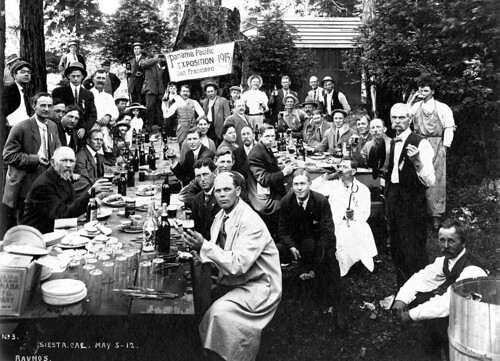
Trainmen from the Bay cities and surrounding area were invited to the party which lasted between 9am and 5pm, the main event being a huge barbecue, pictured here. Citizens from San Francisco with representatives from the Chamber of Commerce and the Panama-Pacific Exposition were present including the official herald, seen towards the back of the photograph. Also present were members of the chambers of commerce of San Jose, Santa Cruz, and Boulder Creek. Local residents were invited to attend and several automobile parties visited throughout the day. Other festivities included fishing, games, motoring, and “a general social cordiality.”

The barbecue menu included “Snapperless Beans a la Missouri, Bulls’ Tails Soup, Mountain Goat Goulash, Brook Trout a la Steelhead Shelby, Surf Sand Dabs a la Casa Del Rey, Baby Bear Fricassee, Boiled Heifer’s Skirts, Boulder Creek Spuds with Wraps, Auntie-Choks from Ben Lomond, California Home Brew, Brookdale Water, Santa Clara Valley Prunes, Tallow Pot Coffee Blend, and Stuffed Doped Hogs Head.” The invitation, published in several regional newspapers, stated that there would be “Plenty to eat and a good informal social time is assured.”

Several locals are pictured here. Closest to the camera, seated, is Fred Moody of Moody and Cress Livery Stables. To the right of Fred is Ben Lomond’s unofficial mayor, bar owner Charles Hartman. Across the table from Fred Moody, seated second from the end is Jacob Kober, who owned a winery on Love Creek, and further down the table in white and holding a butcher’s saw is Myron Swarthout, Boulder Creek’s “Maestro of Meat.”

Map: San Lorenzo Valley Museum.

Tuesday, September 8, 2026

Old Watering Trough

As you travel north from Santa Cruz to Felton along Highway 9, just past Rincon, there is an old concrete watering trough. Bull teams were once watered at this trough and later it became a resting stop for horse teams hauling lumber to Santa Cruz. In 1934, in an effort to reduce nighttime accidents, protruding objects such as rocks and tree stumps were painted white by the State Highway agency, including the old trough.

This prompted an old stage driver to reminisce about the road and the trough. Described only as “one of our early citizens,” he drove the stage from Boulder Creek to Santa Cruz, over Graham Hill Road, before the Highway 9 section from Felton to Santa Cruz had been graded.

The road along the west bank of the San Lorenzo River opened in 1868 to much fanfare. It was an engineering masterpiece, being cut along the canyon wall sometimes hundreds of feet above the water. Money to build the road had been raised by subscription and money to maintain the road was to be raised through tolls.

Once the road was opened, the old stage driver took that route, noting that rarely was he ever passed by another team. “When a bull team, hauling a heavy load of logs or wood, and with wheels in the ruts, was ahead of me, it was sometimes necessary to use a shovel so that the wheels could be steered off the road and the wagon into a cove, then the stage could pass. There were, every so often, recesses cut into the hills where the freighters could pull off to let other travelers pass or the man behind to get by, but when there were a number of freighters strung along the trail it was just a case of watchful waiting.”

He also recalled, “There once were many springs gushing from the mountain sides along the old canyon trail. And trail it was, two ruts with a high center in between. When the ruts got so deep that the center scraped the wagons, there was some repair work done on the road.” During the winter rains the ruts became rivers of mud and wagons often became stuck.

Water Cress, or pepper grass, used to grow along the canyon road in the water from the many springs that trickled alongside. “Mighty good to place in a sandwich,” he reminisced, and the water from the spring that fed the old watering trough was described as “the finest water in the mountains.”


Image: Courtesy of the author.


Ben Lomond's "Con Man"

In April 1905, it was reported that a gentleman named Clarence P. Davis had bought the newspaper

printing plant of the Campbell Visitor with the intent of shipping it to Ben Lomond where he would

“conduct a newspaper in conjunction with some other line of business.” Just one month later the

Santa Cruz Sentinel congratulated newcomer Mr. Davis on his first run of the Ben Lomond News, which

carried “a good quantity of advertising, which is complementary to the progressiveness of Ben

Lomond business men.”


Davis had secured a three-year lease on the Ben Lomond public hall and the Sterling Store and

opened a general merchandising store with a stock of $5000 in goods. By November, Davis was also

the head of a real estate agency, operated a wood yard, was treasurer of the local brass band, and was

president and manager of the Ben Lomond Savings Bank. Earlier that month, he had left Ben

Lomond secretly to marry, in Fresno, Miss Olive Hume, the society editor of the Fresno Democrat,

who was described as a charming girl and a talented writer, well known to the literary world. Miss

Hume also owned a 45 acre ranch in Ben Lomond.


But things were not as they seemed. On December 4, 1905, Davis disappeared while on a short trip

to San Francisco. Over the next few days he contacted his wife to say he had been called first to

Oregon, then Chicago, then El Paso, Texas. It turned out that a new resident of Ben Lomond had

recognized Davis on the train. Davis, it was revealed, was actually Dr. Arthur Clarence Probert,

whom the new resident had known in Dayton, Oregon, where Probert had recently managed a bank

that had failed. Davis did return briefly Monday December 18, only to disappear again.


But this was not all. Davis/Probert had once served as mayor of the Wisconsin city of Washburn

where he owned three banks which collapsed simultaneously and for which he spent time in a

Wisconsin penitentiary. In 1903, he had been arrested in Chicago for using the US mail to defraud

doctors who, for a good sized fee, he would put on the list of consulting physicians of a fake

sanitarium. Indeed, his own claim to the profession of doctor had been a one day attendance at a

Chicago college. The list of prior confidence tricks goes on and on.


The town of Ben Lomond was deeply disturbed by the true nature of “Certainly Promising Davis.”

His wife tried earnestly to continue the newspaper but was forced to sell when the extent of his

accrued debt was understood. His stock and goods at Ben Lomond were sold at an auction by the

sheriff to discharge some of his liabilities.


Meanwhile, Probert had moved to a little town in Colorado, called Molina, about the same size as

Ben Lomond. There, in 1906, he began to conduct similar operations and immediately became a

public man of importance in the community. However, the leading men of Molina were aware of his

past and were keeping a close eye on him. He even remarried, the Sentinel reports, one month prior

to the annulment of the marriage to Miss Hume.


Today the Washburn Area Historical Society is located on the second floor of his “majestic and

historic” brownstone Bank of Washburn. On their website they describe him as “charismatic and

controversial.”


Image: Santa Cruz Sentinel, March 1, 1908.


Felton Toll Gate House

In 1870, Feltonite Otis Ashely complained in a letter to the Santa Cruz Sentinel : “We have a county grog-shop at the toll gate on the San L...