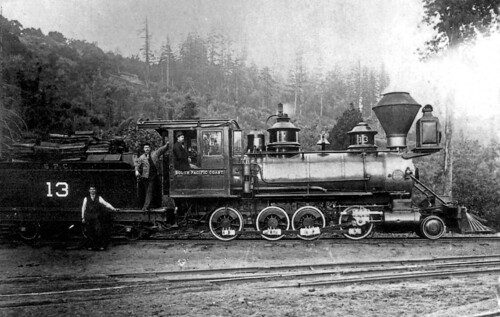
On March 30, 1907, Engineer William Robert Dow suffered a severe stoke while driving a Southern Pacific steam locomotive on his usual route between Santa Cruz and Boulder Creek.
Earlier that day, Dow seemed in the best of health, but on the run home, just opposite Old Felton, he succumbed with “his hand at the throttle of the steel steed which he had driven and controlled so carefully and so well.”
Fortunately, Fireman McDaniels, while backing the engine from a slide where they had been working, noticed that Dow was unable to use his hand to operate the air-brake. McDaniels stopped the engine and Dow was taken to his home where he passed away shortly after. He was one of the most popular engineers employed on the run, which he had operated for the prior twelve years.
Engineer William Robert Dow was the inventor of a new type of compound steam engine, that is a steam engine where the steam is expanded in two or more stages. At the time of his passing, this new engine was intended “to overcome the limitations of the present types in the service of the Southern Pacific Co.” He was also the holder of several patents for gas engines, all filed in the late 1890s, while he was living in the San Lorenzo Valley.
One of his gas engine patents, witnessed by Boulder Creek residents Billy Dool and Arthur Stagg, was cited as prior work in a patent applied for and granted to Major Frank Bernard Halford, a renowned British aircraft engine designer, in 1945, for the patent of a Jet Propulsion Plant. Halford's jet engine company was bought by the De Havilland Aircraft Company. Dow's patent has also been cited more recently, in 1976 and 1984.
The winter of his passing, 1907, had been a wet winter. The San Lorenzo Valley had suffered badly; storms and floods had wreaked havoc. Just a few days before he died, Engineer Dow was pronounced a hero. While transporting a train loaded with school children and passengers just south of Felton his keen eyes noticed the brush on the top of the mountain above Big Trees Park bend and “move slowly down the hill preceded by rolling stones which were beginning to strike the track and the train.”
Quickly, Engineer Dow thrust the engine into reverse and not a moment too soon, “for with a thunderous roar the whole mountain side broke loose.” Five hundred feet of the track was buried in mud, rocks, and trees, to a depth of forty feet, and some of the tracks and ties were thrown into the river below. But the train, and all of its precious cargo, although damaged from the pelting of rocks, were saved.
But even worse weather was to come. The storm on the night of March 23, 1907 saw forty mile an hour gales; the San Lorenzo river rose four and a half feet, and all five of the bridges crossing the river in Boulder Creek were completely swept away, carried by masses of drift material. Roads were impassable with slides and washouts. It took days for the debris to be cleared and it was while clearing one such slide our hero, Engineer Dow, was taken.


No comments:
Post a Comment